
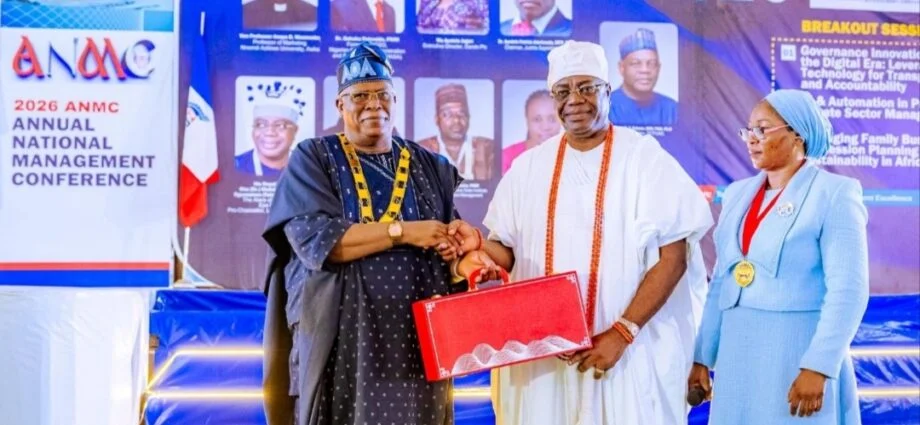
The Alara of Ilara Kingdom in Epe Division of Lagos State, Dr Olufolarin Ogunsanwo, and leadership expert Dakuku Peterside have stressed the need for Nigeria to strengthen its institutions as a foundation for sustainable national development.
The duo made the call at the 2026 Annual National Management Conference (ANMC) of the Nigerian Institute of Management (NIM) Chartered, held in Lagos on Monday.
The conference, which also marked NIM’s 65th anniversary, was organised around the theme, “Sixty-Five Years of Management Excellence: Strengthening Institutional Governance in Nigeria.”
Ogunsanwo argued that Nigeria’s abundant natural and human resources would not automatically translate into development unless the country built institutions capable of delivering stability, accountability and continuity.
He said the focus of governance should move beyond personalities and individual office holders to the systems and structures that sustain effective administration.
According to him, institutions should be supported by clear policies, effective procedures and structures that remain functional regardless of changes in leadership.
He maintained that the true measure of leadership was not only what an individual accomplished while in office but also the strength of the systems established to continue delivering results after the leader’s tenure.
The traditional ruler identified competence, integrity and accountability as essential elements of effective governance.
He also highlighted the role of traditional institutions in grassroots administration, noting that traditional rulers could contribute significantly to peace-building, dispute resolution, community development and social cohesion.
Ogunsanwo called for closer cooperation between traditional and modern governance structures, saying both could complement each other within the framework of the law.
He further urged government, businesses, professional organisations, universities, traditional institutions, civil society groups and citizens to work together in addressing Nigeria’s development challenges.
He said national development should be treated as a collective responsibility rather than the responsibility of one sector alone.
The traditional ruler also advocated a shift from governance based on intentions and promises to a system that measures actual results and impact.
He outlined five areas he considered important for strengthening institutional governance: building institutions instead of personal empires, ensuring accountability, investing in human capital, adopting technology responsibly, and restoring professionalism and integrity in leadership.
Ogunsanwo urged NIM to use its 65th anniversary as an opportunity to renew its commitment to national development and effective management.
Speaking separately, leadership architect Mr Dakuku Peterside said the possession of natural and economic resources did not automatically make countries prosperous.
He explained that sustainable prosperity depended largely on whether institutions had the capacity to transform available resources into productive outcomes.
Peterside said effective institutions must be capable of planning, coordinating, implementing, monitoring and evaluating policies while also learning from mistakes and sustaining successful programmes.
He called for stronger emphasis on merit, professionalism in public administration, data-driven performance assessment and preservation of institutional knowledge.
Peterside also stressed the importance of investing in Nigeria’s young population, saying the country could only benefit from its youthful demographic through sustained attention to education, healthcare, employment, gender equality and good governance.
He argued that leadership should ultimately be assessed by the institutional capacity left behind rather than the level of public applause received during a leader’s tenure.
Meanwhile, NIM President, Commodore Abimbola Ayuba (rtd.), described the institute’s 65th anniversary as a major milestone in its contribution to management development and national progress.
Ayuba said NIM, established in 1961, had contributed to professionalising management and governance through training, certification and executive education.
He added that the institute had also promoted ethical leadership while contributing ideas to national economic policy and civil service reform.
The NIM president called on governments and private-sector organisations to make greater use of the institute’s decades of management research, policy knowledge and practical experience.
He noted that NIM’s multidisciplinary membership, covering fields such as medicine, engineering, law, education, finance and public administration, placed it in a strong position to contribute solutions to Nigeria’s complex challenges.
Ayuba also encouraged government agencies and corporate organisations to provide relevant NIM training and certification for their senior executives.
He reaffirmed the institute’s readiness to expand partnerships with government, businesses and international organisations to strengthen management systems, improve public-sector efficiency and promote accountability.


