
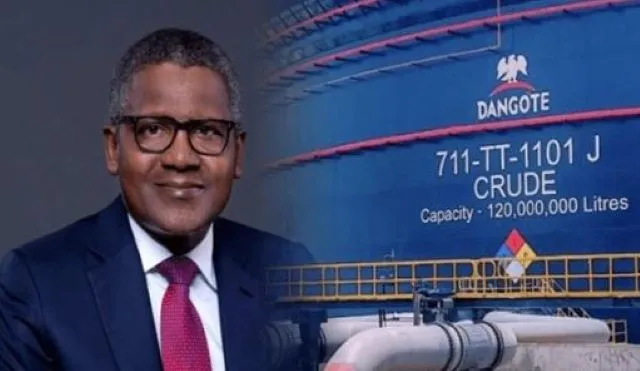
Dangote Industries Limited has acquired an additional 4,000 pieces of construction equipment as work progresses on the expansion of its Lekki refinery in Lagos.
The latest acquisition has increased the company’s construction equipment fleet to about 6,500 machines as Dangote works towards raising the refinery’s processing capacity to 1.4 million barrels of crude oil per day.
The Group Vice President of Oil and Gas and Fertiliser at Dangote Industries, Devakumar Edwin, disclosed this during a briefing with journalists at the refinery in Ibeju-Lekki, Lagos.
Edwin explained that the company initially purchased 2,563 pieces of equipment after Julius Berger and other contractors indicated that they did not have the capacity to undertake construction of some of the refinery’s major factory buildings.
According to him, the decision to build and maintain an extensive equipment fleet was also influenced by the high cost that would have been associated with bringing foreign contractors and their machinery into Nigeria.
He explained that hiring international contractors would require the transportation of their equipment into the country and its eventual removal after the project, with related costs potentially passed on to the project.
Rather than incur those expenses, the company decided to purchase the machinery itself and use the equipment for the refinery project.
The expanded fleet includes 330 cranes, further strengthening Dangote’s construction capacity for the refinery expansion.
Edwin also highlighted the infrastructure challenges associated with executing large-scale industrial projects in Nigeria. He recalled that when Dangote constructed its Apapa sugar refinery in 1998, the country had only a limited number of heavy-duty cranes.
For the Lekki refinery project, the company also had to secure access to one of the world’s largest cranes, with a lifting capacity of 5,000 tonnes.
The company’s existing infrastructure is expected to support the expansion and reduce the time and cost required to execute the second phase of the refinery project.
Some of the facilities already available at the complex include a granite quarry, concrete batching plants, transit mixers, a private port, an oxygen and welding-gas plant and accommodation facilities.
The refinery, originally designed with a capacity of 650,000 barrels per day, is currently processing about 700,000 barrels per day, according to Edwin. The planned expansion would take its capacity to approximately 1.4 million barrels per day.
Edwin had earlier disclosed that basic engineering for the expansion had been completed, with most of the equipment required for the project already ordered. The company is targeting completion of the expansion within about three years, although it said the work could be completed sooner.
The expansion is expected to further increase the refinery’s contribution to Nigeria’s domestic petroleum supply while strengthening Dangote’s ability to serve markets within and outside the country.
The company is also pursuing wider investments in petrochemicals, gas infrastructure and fertiliser production as part of its broader industrial expansion strategy.