For Esther Olabiyi, having access to computers, smartphones and other digital devices did not automatically translate into an understanding of how technology could be used to build practical skills.
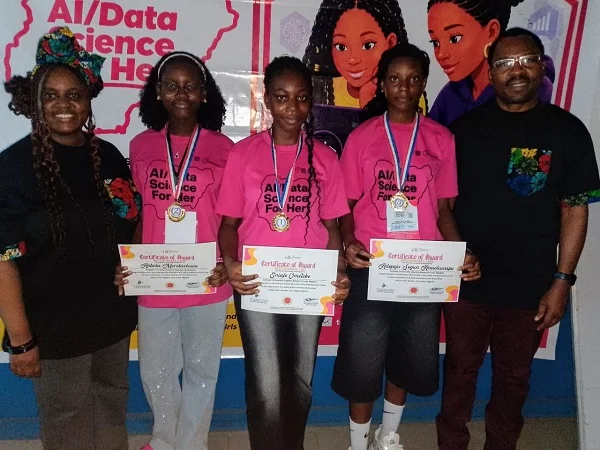
That changed when the SS3 student of Ibadan Grammar School participated in the AI/Data Science for Her 2026 programme organised by Tech Girls Club.
The five-day training introduced Olabiyi to programming, Python and Microsoft Excel, exposing her to possibilities in technology that she had previously not considered.
Her experience reflects a wider challenge facing efforts to increase the participation of girls in Science, Technology, Engineering and Mathematics (STEM) in Nigeria.
While access to digital devices is increasing, many young girls still lack the training, mentorship and practical opportunities needed to turn that access into useful technological skills.
The gender gap is also reflected in global education statistics.
According to UNESCO data cited in the report, women now outnumber men in higher education globally, with 114 women enrolled for every 100 men. However, women account for only about 35 per cent of STEM graduates.
Nigeria faces an even wider disparity, with women representing approximately 22 per cent of STEM graduates, according to data from the National Bureau of Statistics.
For girls interested in STEM, the obstacles can extend beyond access to technology. Limited exposure, inadequate infrastructure, teaching approaches that rely heavily on theory and memorisation, and a lack of practical learning opportunities can also affect participation.
The AI/Data Science for Her programme was developed to address some of these challenges by giving secondary-school girls hands-on exposure to emerging technologies.
The initiative was implemented across Nigeria’s six geopolitical zones, with training sessions held in Ilorin, Yola, Port Harcourt, Zaria, Nsukka and Ibadan.
It was supported through a 2026 Bridging the Future grant from the NeurIPS Foundation.
The foundation said the programme was designed to train 300 Nigerian secondary-school girls in the fundamentals of artificial intelligence and data science.
Participants received practical instruction in areas including artificial intelligence, data science, programming and digital skills.
Wonderful Osalor, Project Manager of the initiative, said participants entered the programme with different levels of familiarity with technology.
For some, the training represented their first opportunity to engage with programming and data science in a structured and practical environment.
The programme therefore sought not only to introduce participants to technical concepts but also to demonstrate how those skills could be applied to real-world problems.
The experience of students such as Olabiyi highlights the importance of moving beyond simply providing young people with access to computers and internet-enabled devices.
Effective digital inclusion also requires training, mentorship and opportunities for young people to experiment, create and develop confidence in using technology.
As Nigeria continues to seek greater participation in the digital economy, increasing the number of girls entering STEM fields could help broaden the country’s pool of future programmers, engineers, data scientists and technology entrepreneurs.
For the girls who participated in the programme, the exposure could also represent an early step towards considering careers in areas of technology that may previously have seemed unfamiliar or inaccessible.