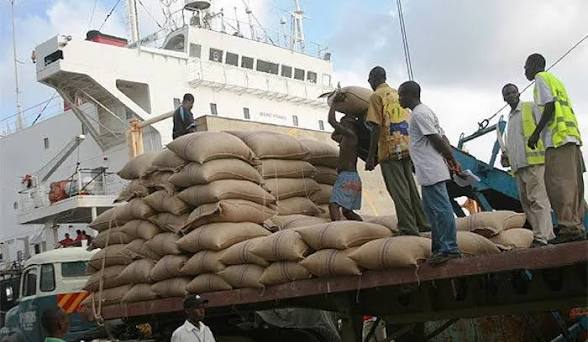
Nigeria’s foreign exchange spending on food imports increased to $1.19 billion in the first six months of 2026, highlighting the country’s continued reliance on overseas food supplies despite ongoing efforts to strengthen domestic agricultural production.
The figure represents an 11.41 per cent increase, or about $121.52 million, compared with the $1.07 billion recorded during the same period in 2025, according to data contained in the Central Bank of Nigeria’s second-quarter 2026 Statistical Bulletin.
The latest figures suggest that demand for foreign food supplies remains substantial, even as the Federal Government pursues policies aimed at increasing local production and reducing dependence on imports.
April Records Biggest Year-on-Year Increase
The CBN data showed that food-related foreign exchange utilisation increased in five of the six months under review. February was the only month that recorded a year-on-year decline.
In January, spending rose to $232.05 million from $213.11 million a year earlier, representing an 8.89 per cent increase.
February provided a temporary reversal, with spending falling 22.90 per cent to $150.87 million from $195.68 million in February 2025.
The upward movement resumed in March, when food import-related forex utilisation reached $153.73 million, compared with $141.30 million in the corresponding month of 2025.
April recorded the most significant annual increase. Spending jumped 54.28 per cent to $217.74 million, compared with $141.13 million a year earlier.
The increase continued in May, with forex utilisation rising 8.59 per cent to $220.26 million from $202.83 million. In June, spending climbed by 23.92 per cent to about $212 million, up from $171.08 million in June 2025.
Second Quarter Drives Overall Increase
On a quarterly basis, the first three months of the year had initially suggested a modest improvement.
Food import forex utilisation fell 2.57 per cent in the first quarter, dropping from $550.79 million in the first quarter of 2025 to $536.65 million during the same period in 2026.
However, the situation changed significantly in the second quarter.
Between April and June, spending increased by 26.38 per cent, rising from $514.34 million in the second quarter of 2025 to approximately $650 million in 2026.
The sharp second-quarter increase more than cancelled out the first-quarter decline and ultimately pushed total food import forex spending higher for the first half of the year.
Insecurity Remains a Major Concern
Agricultural stakeholders have continued to point to insecurity as one of the major factors restricting Nigeria’s ability to produce enough food locally.
Femi Egbesola, President of the Association of Small Business Owners of Nigeria, said insecurity had forced farmers to abandon some agricultural areas, disrupting the supply of raw materials to manufacturers and other businesses.
He also identified inadequate access to modern agricultural technology as another obstacle to improving productivity.
According to Egbesola, Nigeria needs greater investment in mechanisation and modern farming equipment, particularly for smallholder farmers, if domestic production is to increase substantially.
He argued that farmers cannot consistently supply the food and raw materials required by the wider economy when large numbers are unable to safely access their farms.
Sanusi Raises Concern Over Import Competition
The Emir of Kano, Muhammadu Sanusi II, has also expressed concern about the potential impact of food imports on local agricultural businesses.
Sanusi previously argued that increased imports, including rice from Thailand, had weakened domestic rice mills and created financial difficulties for some banks that had invested in the agricultural value chain.
While acknowledging that imported food can help ease shortages and reduce prices for consumers, he warned that excessive dependence on foreign supplies could weaken domestic production over time.
He therefore called for policies that protect low-income households from high food prices while also giving local farmers and agricultural businesses sufficient room to compete and expand.
Food Self-Sufficiency Remains a Challenge
The latest CBN figures underscore the difficulty Nigeria faces in achieving greater food self-sufficiency.
Although the government has continued to promote domestic agriculture, persistent insecurity, limited mechanisation and production constraints remain significant barriers to increasing local food supplies.
For Nigeria to reduce its dependence on imported food, stakeholders say greater attention will be needed in areas such as farm security, access to modern equipment, agricultural infrastructure and support for small-scale producers.
The $1.19 billion spent on food imports during the first half of 2026 therefore represents not only increased foreign exchange demand but also a continuing challenge for efforts to build a stronger and more self-reliant agricultural sector.