

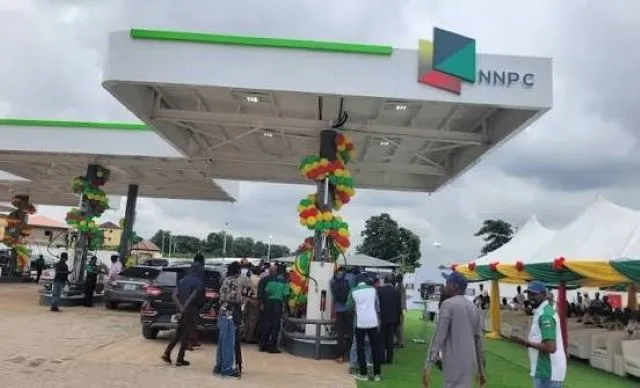
The Nigerian National Petroleum Company Limited (NNPCL) has inaugurated its first smart fuel station in Nigeria, introducing a self-service model as part of its plan to transform conventional filling stations into broader energy hubs.
The facility, located along Bill Clinton Drive on Airport Road in Abuja, operates around the clock and is equipped with facilities designed to provide motorists with multiple energy and convenience services.
NNPCL also announced plans to establish between 50 and 70 additional smart stations across the country within the next six months.
NNPCL Targets Wider Smart Station Rollout
The company’s Downstream Executive Vice President, Mumuni Dagazao, disclosed the expansion plan while speaking with journalists during the commissioning ceremony.
He explained that the newly commissioned facility represents the first of several smart stations planned by NNPCL as the company moves towards a technology-driven retail network.
Dagazao said the company would prefer to achieve significant technological transformation of its stations within about 10 months rather than work with a longer 10-year timeline.
He also encouraged consumers to challenge the company to deliver on its targets.
Station Offers Multiple Energy Services
The new smart station currently provides Premium Motor Spirit (PMS) and Automotive Gas Oil (AGO) through its vending pumps.
Facilities for compressed natural gas (CNG) and liquefied natural gas (LNG) are expected to be introduced later.
The station also features an electric vehicle charging facility powered by a solar installation on the roof of the building.
According to information contained in the report, the electric vehicle charging service is understood to cost about ₦400 per kilowatt, while a full charge costing approximately ₦16,000 could provide a driving range of about 400 kilometres.
The charging process reportedly takes approximately 40 minutes.
From Filling Stations to Energy Hubs
NNPCL said the initiative is designed to change the traditional concept of a filling station into a more comprehensive energy hub.
Dagazao explained that consumers increasingly expect more services at fuel stations beyond purchasing petrol and diesel.
The NNPC Retail Managing Director, Hope Stockman, said the company was focused on meeting customers’ expectations by providing quality products, accurate quantities and competitive prices.
He added that future facilities could incorporate services such as fast-food outlets, convenience stores, coffee shops, banking facilities, lubrication services and car washes.
The inauguration was attended by representatives of the Nigerian Midstream and Downstream Petroleum Regulatory Authority (NMDPRA), Nigerian Immigration Service, Nigerian Navy and Africa Motor World.
The development marks a shift towards technology-enabled fuel retailing and reflects NNPCL’s stated ambition to modernise its downstream operations across Nigeria.