
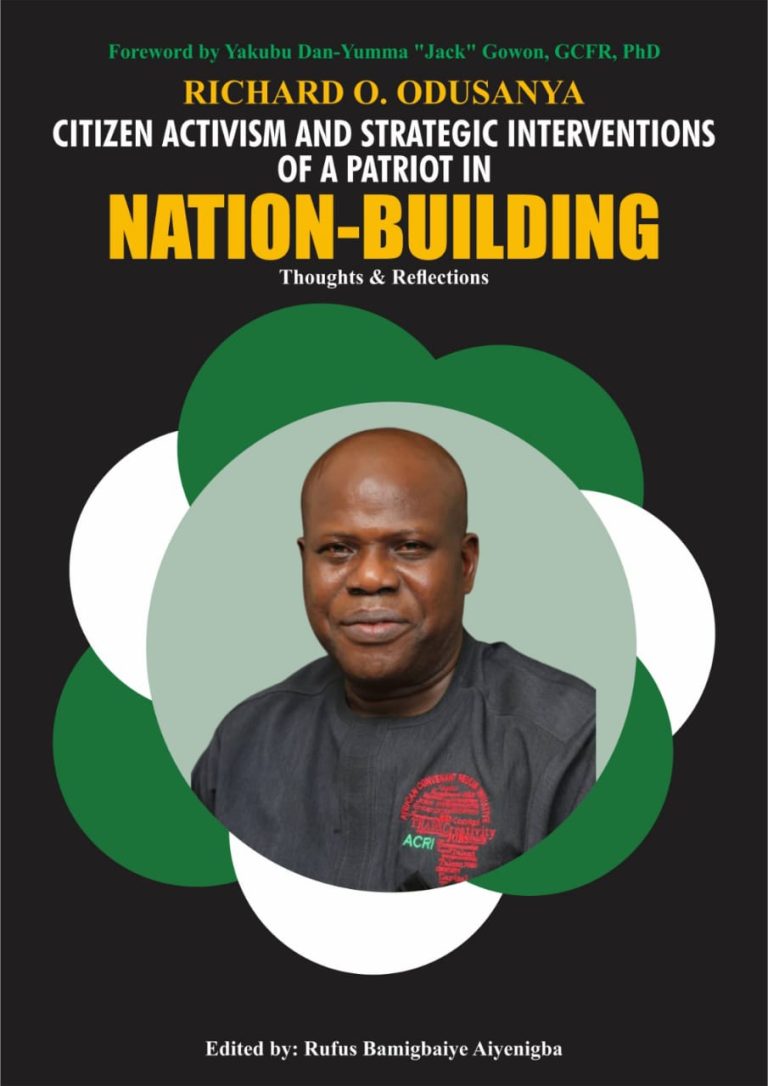
Public affairs commentator Richard Odusanya has reflected on the purpose of writing about Nigeria, saying his work is intended to preserve a record of the country’s experiences for future generations.
Odusanya said the late Nigerian-Canadian scholar, Prof. Pius Adesanmi, strongly influenced his thinking about writing and its importance as a historical record.
According to Odusanya, Adesanmi believed that written accounts could serve as fragments for future generations seeking to understand how Nigerians lived and responded to the challenges of their time.
Odusanya said that idea inspired his work with WITNESS 2026 and CIVICS ARCHIVES, which he described as efforts to document issues affecting Nigerian society.
One of the issues he has chosen to examine is dual citizenship and the responsibilities that come with having the opportunity to live in more than one country.
Dual Citizenship and National Responsibility
Odusanya disclosed that he is the father of three dual citizens and said his position should not be interpreted as opposition to Nigerians holding citizenship in other countries.
Instead, he argued that access to another country should come with a consideration of what responsibilities an individual still owes to Nigeria.
He used the life of Adesanmi as an example, noting that although the late scholar was Nigerian-Canadian and worked in Canada, he maintained strong intellectual and professional connections with Nigeria.
Odusanya contrasted this with what he described as a growing tendency among some Nigerians to view foreign citizenship primarily as an escape from the difficulties confronting the country.
He recalled a conversation involving Pastor Abraham Ojeme concerning why the pastor’s grandson was not being educated in Nigeria.
According to Odusanya, the response was that the family did not want to expose the child to Nigeria’s difficulties.
Odusanya said the statement reflected a broader concern about how some citizens increasingly perceive Nigeria—not as a country to help improve, but as a place from which they should seek protection.
Four Issues for Future Generations
Odusanya identified four areas he believes should form part of the historical record concerning dual citizenship.
The first, he said, is the emergence of different classes of Nigerians based on their ability to leave the country when conditions deteriorate. While some people have alternative places to live, others remain entirely dependent on circumstances within Nigeria.
The second concerns the economic balance between the benefits of Nigerians living abroad and the losses associated with the migration of skilled professionals and the movement of capital outside the country.
He also raised questions about national allegiance, particularly where public officials possess citizenship or strong ties to other countries.
Odusanya argued that the issue becomes more complicated when access to another country could potentially be used to avoid accountability in Nigeria.
His fourth concern is what he described as the need to build a “bridge” between Nigeria and the opportunities available abroad.
Rather than viewing foreign citizenship solely as an escape mechanism, he argued that Nigerians in the diaspora can use their resources, knowledge and connections to contribute to solving problems at home.
Proposed Ways Forward
Odusanya proposed several measures aimed at encouraging greater responsibility among Nigerians with dual citizenship.
Among his suggestions is greater disclosure of second citizenship by politically exposed persons during screening processes.
He also proposed commitments requiring public officials to remain subject to Nigerian legal processes rather than using another nationality as a means of avoiding accountability.
Another proposal is to strengthen the practical value of Nigerian citizenship by addressing issues surrounding residency and the distinction between so-called indigenes and settlers.
He further advocated a Diaspora Stewardship Bond designed to encourage Nigerians abroad to invest in areas such as laboratories, primary healthcare facilities and other productive infrastructure.
Leaving a Record
Odusanya said his ultimate objective is to leave behind evidence showing that some Nigerians recognised the country’s difficulties but chose to contribute rather than remain silent.
He maintained that holding another citizenship is not inherently wrong, but argued that the privileges associated with it should be accompanied by a sense of responsibility toward one’s country of origin.
For Odusanya, writing is therefore more than commentary. It is a way of documenting the choices, struggles and ideas of the present generation so that they can be examined by those who come after it.
The views expressed in this article are those of Richard Odusanya, the original author of the opinion piece.


