


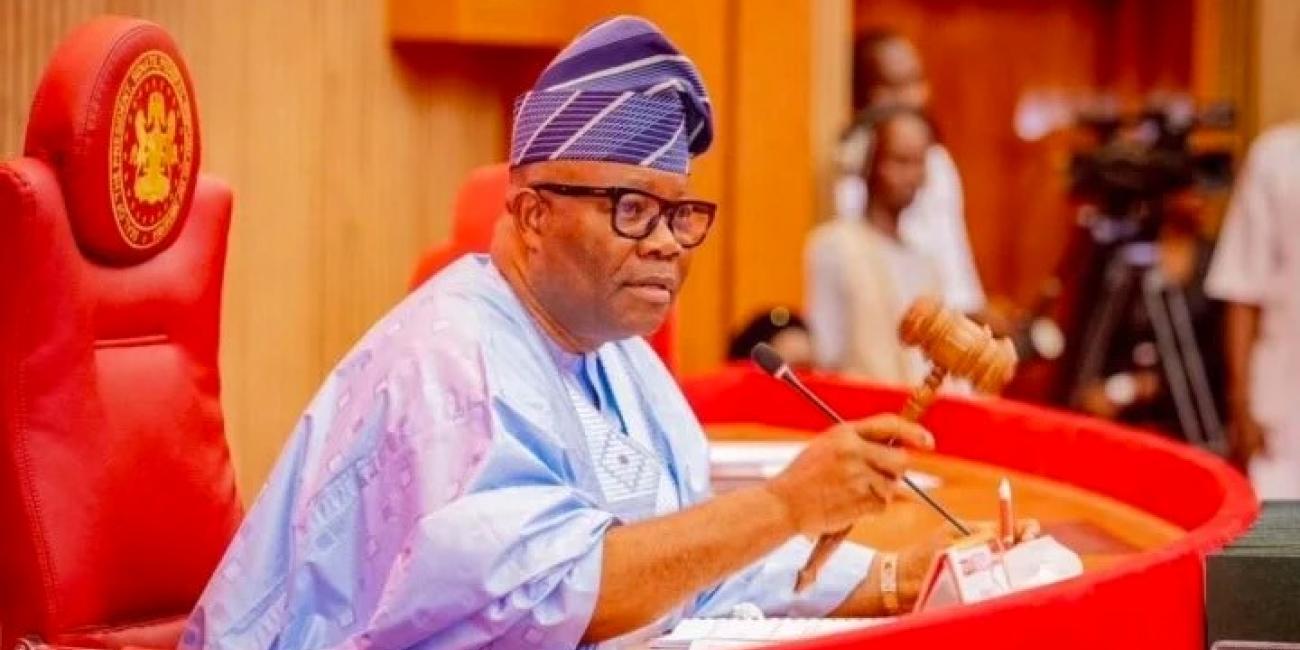
The Nigerian Senate has withdrawn its earlier approval of the Proceeds of Crime (Recovery and Management) (Amendment) Bill, 2026, a development that has triggered concerns over the proposed creation of a specialised agency to manage assets linked to criminal activities.
The reversal has also prompted allegations that Senate President Godswill Akpabio may have influenced the decision to halt the establishment of the proposed Proceeds of Crime (Recovery and Management) Agency. However, the allegation has not been established as fact.
The bill, sponsored by Senator Idiat Adebule, representing Lagos West, had passed through several stages of the legislative process before its approval on July 9, 2026. It underwent first and second readings, committee review, a public hearing, clause-by-clause consideration of 51 provisions and a third reading.
Despite the earlier approval, Senate Leader Michael Opeyemi Bamidele later moved a motion seeking to rescind the chamber’s decision.
The motion stated that the Senate wanted to withdraw its July 9 decision to allow the bill to undergo further review and ensure that its provisions complied with Nigeria’s constitutional framework and international standards on asset recovery.
Concerns Over the Reversal
The development has raised questions among civil society groups and other stakeholders, particularly because the bill had already gone through extensive legislative scrutiny.
A coalition of civil society organisations has urged the Senate to explain the specific legal, constitutional, drafting or policy concerns that led to the reversal.
The groups said they were particularly concerned that the bill was withdrawn after completing the legislative process without the public being given detailed reasons for the decision. They also called for transparency over reports suggesting that Akpabio may have influenced Bamidele’s decision to seek rescission.
The coalition stressed that such claims should not be regarded as proven but argued that they warranted clarification because of the importance of the proposed legislation.
Proposed Agency Had Broad Mandate
The proposed legislation was designed to create a central agency responsible for tracing, recovering, preserving, managing and disposing of assets believed to have been obtained through unlawful activities.
Under the bill, the proposed agency would have operated as a corporate body with perpetual succession and the authority to sue and be sued.
It was also expected to have its headquarters in Abuja and the power to establish zonal offices where necessary.
The proposed framework included provisions dealing with the restraint, seizure, confiscation and forfeiture of assets connected to criminal activity. It also introduced a non-conviction-based mechanism for recovering proceeds of crime.
The Senate Judiciary, Human Rights and Legal Matters Committee had recommended the agency after a public hearing in February 2026. The committee reportedly received submissions from 22 organisations and individuals, including law enforcement agencies, professional bodies and civil society organisations.
Bamidele’s Role Raises Questions
The reversal has attracted additional attention because Bamidele, who later moved the rescission motion, was also a member of the Senate committee that reviewed the legislation and recommended the establishment of the agency.
The bill had been considered and approved clause by clause by the Senate on July 9 before it was read for the third time and passed.
The subsequent rescission therefore means the proposed agency no longer has the legislative approval it obtained in July. For the agency to proceed on the basis of the proposed legislation, the bill would have to be reconsidered and passed again.
Senate Yet to Give Detailed Explanation
Although the rescission motion referred to the need for further scrutiny and alignment with legal and international standards, public information released so far has not clearly identified the specific provisions considered problematic.
The development has consequently intensified calls for the Senate to disclose the reasons behind the reversal and explain what changed between the bill’s approval in July and the decision to rescind it.
The proposed agency was viewed as an attempt to address concerns surrounding the fragmented management of recovered assets in Nigeria. Supporters argued that a centralised institution could improve coordination, accountability and efficiency in the recovery and management of proceeds of crime.
EFCC Chairman Ola Olukoyede had earlier described the legislation as a positive development in Nigeria’s anti-corruption efforts.
With the Senate’s latest decision, however, the proposed framework has been put back into the legislative process, leaving stakeholders waiting for clarification on whether lawmakers will reconsider the bill and what changes may be introduced.