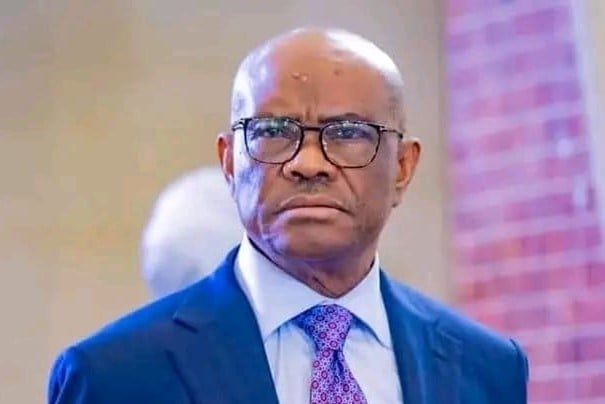
Ancient Yoruba wisdom says that anyone who seeks only the head and limbs of a tortoise will eventually end up buying the entire creature. That proverb captures the growing tension between the 31-member Progressive Governors Forum (PGF) and FCT Minister, Nyesom Wike.
Wike’s political alignment with President Bola Tinubu and his support for the President’s 2027 bid have increasingly brought him into conflict with APC governors, particularly over his Rainbow Coalition and its political activities. The governors have maintained that they will not support arrangements they believe could weaken the APC’s structure or its candidates.
Territorial War
The disagreement generated considerable political tension last week, with APC figures publicly reacting to Wike’s activities and criticisms of some governors.
APC chieftain Farouk Aliyu, speaking on Arise TV, acknowledged that Wike had become a source of distraction for the party. At the same time, the Progressive Governors Forum maintained that it would not endorse a political arrangement outside the official APC structure.
The position was reinforced by the governors’ insistence that campaign structures in their respective states would remain under their control rather than being directed by Wike’s coalition.
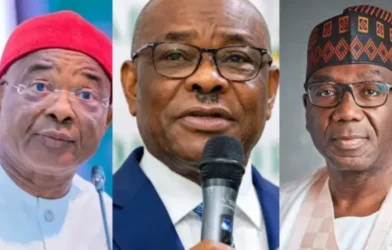
Wike, however, has continued to defend his political activities and has criticised governors whom he believes are working against his efforts. He previously singled out Kwara State Governor AbdulRahman AbdulRazaq and Imo State Governor Hope Uzodinma in discussing his disagreements with some APC governors.
Wike’s Reaction
The dispute has also produced sharp exchanges between Wike and members of the APC.
Wike has accused some governors of political manoeuvring against him, while maintaining that his principal objective is to support President Tinubu’s re-election bid.
APC figures, meanwhile, have criticised his comments about party leaders and questioned his role in political activities involving APC members.
The APC South-East caucus recently called on Wike to apologise to the party’s governors, accusing him of disrespecting their political capacity and attempting to interfere with their political fortunes.
Beyond the public exchanges, the disagreement reflects a broader struggle over political influence and control ahead of the 2027 elections.
The relationship between Wike and the APC has been unusual because Wike remains a member of the Peoples Democratic Party while serving as a minister in the APC-led Federal Government. His decision to support Tinubu has consequently placed him in an unusual political position.
Manifestations
The present conflict has exposed the complications created by that arrangement.
Wike has defended his decision to support Tinubu, arguing that political circumstances require him to work toward the President’s re-election. At the same time, APC governors have sought to protect their party structures and political interests in their respective states.
The resulting tension has raised questions about how Wike’s political coalition will coexist with the APC’s established structures as the 2027 election approaches.
For the governors, the issue is about preserving the authority of the party and its elected structures. For Wike, his public statements indicate that supporting Tinubu remains his priority, even when that position brings him into conflict with some APC leaders.
The coming months will reveal how the competing interests are managed as political parties and alliances prepare for the 2027 elections.