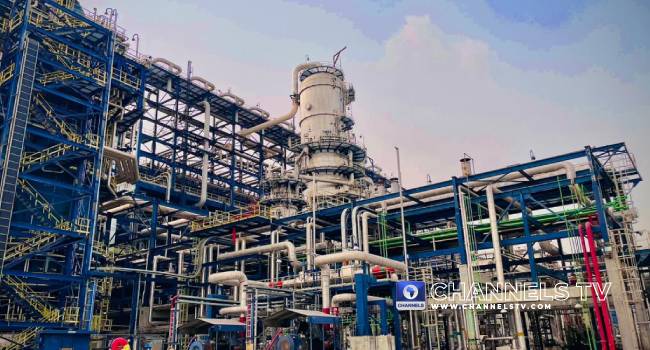
The Federal Government has disclosed that Nigeria currently does not have enough available crude oil to meet the full requirements of the Dangote Petroleum Refinery, highlighting ongoing challenges in supplying domestic refineries.
Minister of Finance and Coordinating Minister of the Economy, Taiwo Oyedele, made this known during an appearance on Channels Television’s Politics Today programme on Friday, October 9, 2026.
Oyedele’s remarks came amid renewed calls for the government to introduce a production subsidy to support local refineries and help address the rising cost of petroleum products.
He explained that although Nigeria produces approximately 1.8 million barrels of crude oil daily, the entire volume is not available for the Federal Government to allocate freely to domestic refiners.
According to the minister, crude oil produced in the country is distributed among stakeholders under production-sharing contracts and joint-venture agreements. Additional portions are also used to cover production expenses and royalty obligations before the government’s share of the remaining oil is determined.
Consequently, the quantity available for allocation to local refineries is significantly lower than the country’s total daily output.
Dangote Refinery Still Depends on Imported Crude
Oyedele said Nigeria was not yet in a position to supply the Dangote Refinery with the 700,000 barrels of crude oil it requires daily at its stated processing capacity.
He maintained that the government could not realistically promise discounted crude supplies based on production costs when the volume required was not available.
The minister also noted that the refinery would still need to import certain grades of crude oil, even if Nigeria could provide the full quantity it requires, because domestic crude grades do not entirely match its processing needs.
His comments underline the challenges of ensuring a consistent supply of suitable crude oil as Nigeria expands its domestic refining capacity.
The Dangote Refinery, located in the Lekki area of Lagos State, is expected to play a significant role in meeting domestic demand for refined petroleum products and reducing dependence on imported fuel.
However, securing adequate crude supplies remains an important factor in achieving these objectives.
FG Defends Naira-for-Crude Arrangement
The finance minister also defended the Federal Government’s naira-for-crude initiative, introduced to support domestic refining and improve stability in the petroleum market.
Oyedele said the arrangement had helped provide some stability but acknowledged that the volume of crude available remained insufficient to satisfy the full needs of the Dangote Refinery and other local processors.
He expressed optimism that continued efforts to increase crude oil production and free up additional volumes would eventually enable Nigeria to supply domestic refineries more consistently.
The government has been pursuing measures to address crude oil theft, improve production and renegotiate certain commitments that limit the quantity available to the country.
Oyedele said the long-term objective should be for Nigeria to process its crude oil locally and export refined petroleum products rather than rely heavily on exporting unprocessed crude.
Production Subsidy Debate Continues
The minister’s comments come amid growing debate over proposals to support domestic refineries through production subsidies.
Some opposition figures have advocated government intervention to reduce the cost of petroleum products, while the Federal Government has maintained that crude availability remains a major constraint.
Oyedele’s position is that reducing the price of crude supplied to refineries would not resolve the problem if the government lacks sufficient uncommitted barrels to meet their requirements.
The discussion has also revived questions about the effects of the government’s 2023 decision to remove petrol subsidies and introduce broader economic reforms.
Although the reforms were intended to ease pressure on public finances, higher fuel prices have increased transportation costs and added to the financial difficulties faced by households and businesses.
Higher Production Seen as Key to Meeting Domestic Demand
The Federal Government believes that increasing crude oil production will be essential to meeting the needs of the Dangote Refinery and other domestic refiners.
Greater output could make more crude available for local processing, provided existing contractual obligations and other allocations are accounted for.
For Nigeria to achieve its ambition of becoming a major refining hub, the country will also need reliable crude supply arrangements, suitable oil grades, efficient transportation infrastructure and stable policies.
Oyedele said he hoped Nigeria would eventually reach a stage where all the crude oil it produces could be refined locally, with only finished petroleum products exported to international markets.
For now, however, the availability of crude oil remains a significant challenge for the country’s domestic refining ambitions.