

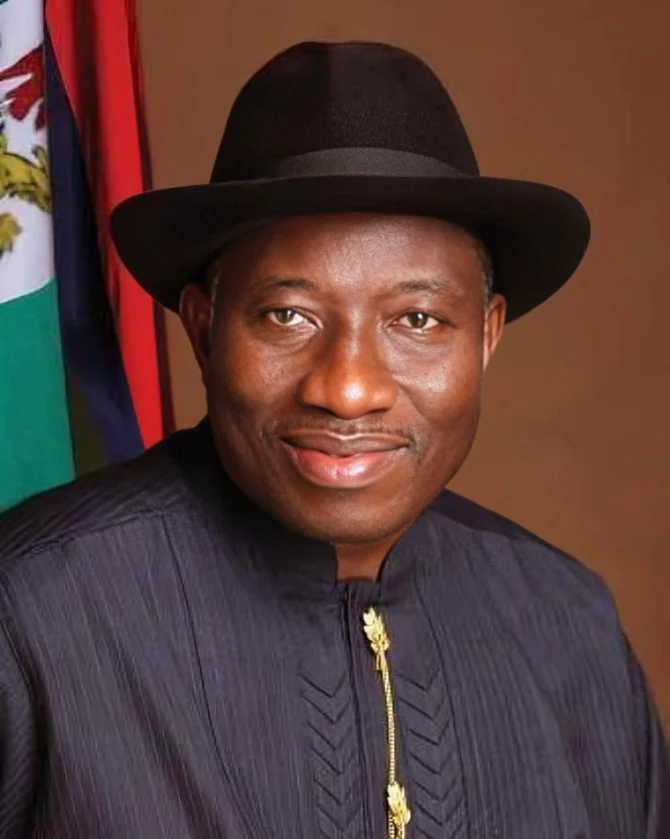
Former President Goodluck Jonathan has called for a broader approach to tackling terrorism in Nigeria, supporting the position of retired Inspector-General of Police Mohammed Abubakar that security efforts must extend beyond the use of military force.
Jonathan made the remarks on Saturday in Abuja during the presentation of Abubakar’s book, Beyond the Bullets: Policing Terrorism in a Democratic System.
Represented by his former Chief of Staff, Chief Mike Oghiadomhe, the former president said terrorism remained a persistent national and global challenge requiring sustained commitment, cooperation and institutional learning across successive administrations.
He said the fight against terrorism should not be viewed as the responsibility of one government alone, stressing the need for continuity in security policies and collaboration among relevant institutions.
Jonathan expressed support for the book’s central argument that counterterrorism measures must go beyond kinetic operations, which involve the direct use of force by security agencies.
Jonathan Highlights Education, Employment
The former president cited initiatives introduced during his administration, including Almajiri schools, as examples of efforts to address social challenges that could leave young people vulnerable to recruitment into violent groups.
He explained that the initiative sought to expand educational opportunities for Almajiri children by combining religious education with skills that could help them earn a living and contribute to national development.
Jonathan also urged the Federal Government to revisit the Great Green Wall initiative, which was designed to combat desertification while creating opportunities for agriculture, livestock production and employment in affected communities.
According to him, such programmes could contribute to addressing some of the social and economic conditions associated with insecurity.
Retired Police Chief Advocates Democratic Policing
Abubakar said his book drew on more than three decades of policing experience and examined how terrorism challenges democratic institutions, the rule of law and public confidence.
He argued that security challenges could not be resolved solely through military and police operations, noting that effective responses required proper planning, coordination, intelligence gathering, risk assessment and accountability.
The retired police chief also warned against treating entire communities as suspects during counterterrorism operations.
He maintained that security agencies must protect citizens while respecting human dignity and democratic principles.
According to him, terrorism involves more than acts of violence, as perpetrators may also seek to spread fear, provoke excessive responses and undermine confidence in public institutions.
Reviewer Calls for Balance Between Force and Non-Military Measures
The book reviewer, Professor Etannibi Alemika, said the publication highlighted the need to balance military and non-military strategies in addressing Nigeria’s persistent security challenges.
He noted that the book examined the relationship between terrorism, democracy, civil liberties and national security, while exploring how intelligence-led policing and community-based strategies could help prevent and combat violent threats.
Alemika also discussed the challenges involved in defining terrorism and distinguishing between different forms of violence and security threats.
The discussions at the event underscored the importance of combining security operations with intelligence, community engagement, economic opportunities and institutional accountability.
Jonathan’s remarks add to ongoing calls for a comprehensive approach to insecurity in Nigeria, with an emphasis on protecting citizens while addressing factors that may contribute to the recruitment and activities of violent groups.


