

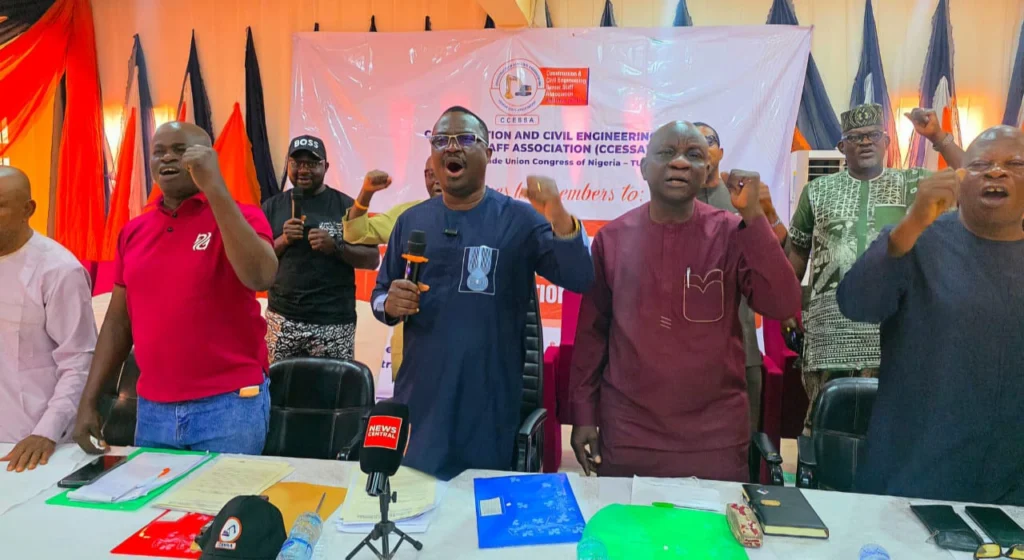
The Construction and Civil Engineering Senior Staff Association of Nigeria (CCESSA) has called on President Bola Ahmed Tinubu to take urgent steps to address insecurity, rising living costs and other challenges threatening Nigeria’s construction and civil engineering sector.
The appeal was contained in a communiqué issued after the association’s National Executive Committee meeting in Abuja and signed by its National President, Dr Ayodeji Adeyemo, and General Secretary, Sunday James.
While acknowledging the Federal Government’s economic reforms and infrastructure development efforts under the Renewed Hope Agenda, CCESSA said workers and their families were still facing difficult economic conditions that required sustained government intervention.
The association stressed that the construction industry could not operate effectively in an environment where engineers, contractors, technicians and other workers were exposed to insecurity and threats to their lives and property.
It therefore urged the government to strengthen efforts against terrorism, banditry, kidnapping, communal violence and other criminal activities. It also called for improved intelligence gathering, stronger cooperation among security agencies and faster responses to security threats.
CCESSA further asked the Federal Government to provide adequate protection for major construction sites and infrastructure corridors, particularly in areas affected by insecurity.
Beyond security, the association called for measures aimed at reducing the cost of living. It recommended policies to stabilise food prices, increase domestic agricultural production and support farmers and food-processing businesses.
The group also urged the government to reduce transportation and logistics expenses while encouraging local production of essential items, including medicines and construction materials.
According to the association, stronger monitoring is needed to check exploitative pricing and anti-competitive practices that increase the cost of goods and services and place additional pressure on households and businesses.
Concerns Over Contractors’ Payments
The association also expressed concern over the ongoing disagreement between the Federation of Construction Industry (FOCI) and the Federal Ministry of Works.
It warned that prolonged disputes between contractors and government could disrupt construction activities, threaten jobs and negatively affect businesses connected to the sector.
CCESSA noted concerns raised by FOCI over unpaid certified work, funding difficulties and contract terminations, saying the issues required urgent attention.
To resolve the situation, the association proposed a high-level tripartite mechanism involving the Federal Government and Ministry of Works, FOCI, trade unions and professional bodies in the construction and civil engineering industry.
It said the mechanism should help resolve outstanding contractual and payment disputes and create a transparent system for verifying and paying for completed and certified work.
The association also recommended that genuine changes in project costs caused by fluctuations in material prices and other economic conditions be reviewed before viable projects are cancelled or suspended.
Call to Protect Construction Jobs
Adeyemo said the construction industry should be regarded as a strategic component of Nigeria’s economy because of its capacity to create employment and provide essential infrastructure such as roads, bridges, housing, hospitals and schools.
He warned that job losses in the sector could have wider economic consequences, affecting dependants as well as businesses such as transport operators, food vendors, retailers, landlords and schools that rely on workers’ incomes.
The CCESSA president called for stronger government programmes targeting decent employment, social protection, small and medium-sized enterprises, food affordability, transportation, healthcare and education.
He urged President Tinubu to bring relevant stakeholders together to resolve the problems confronting the sector and restore confidence among workers, contractors, investors and other industry participants.
The association said protecting Nigerian jobs and improving citizens’ welfare should remain central to government decisions on infrastructure development and economic policy.


